The City Carved into the Rocks Above the Yantra
There are cities that unfold gently across a plain, and there are cities that literally rise before your eyes. Veliko Tarnovo belongs entirely to the second category. Perched on steep slopes sculpted by the meanders of the Yantra River, this historic centre offers a landscape rarely rivalled anywhere in Europe. Houses are stacked one above the other, as if each rests on the eaves of the one below, woven together by narrow cobbled streets, stone staircases, and quiet green courtyards.
For anyone exploring Bulgaria for the first time or seeking a home with distinctive character, Tarnovo imparts a profound sense of permanence. Here, history is not a museum display behind glass, but a natural living environment. Locals cross centuries-old bridges on their way to work, and panoramic views of dramatic rock ledges are part of an everyday life that never grows routine.
Tsarevets and Trapezitsa: The Legacy of Bulgarian Tsars
As the capital of the Second Bulgarian Empire, Veliko Tarnovo preserves the memory of an era of cultural and political brilliance. At the core of this narrative stands Tsarevets Hill, encircled on three sides by the river's dramatic curve. Access to the fortress leads across a stone bridge and through the main gate, where the grounds reveal the foundations of the former royal palace, the patriarchal complex, and dozens of residential and commercial quarters.
A walk along the crest of Tsarevets brings you to the Patriarchal Cathedral of the Holy Ascension, whose striking modern murals depict the most dramatic chapters of Bulgarian history. From the northern edge of the hill, at Baldwin's Rock (Execution Rock), breathtaking views plunge down to the river and out across the surrounding hills.
Opposite Tsarevets rises Trapezitsa Hill. In recent years, it has been restored for visitors and connected by a modern funicular that makes the ascent effortless. There, ongoing archaeological excavations continue to reveal the foundations of dozens of boyar churches featuring impressive medieval architecture and preserved fresco fragments. Together, these two hills form the historic core around which the identity of the entire region is built.
Samovodska Charshiya: Living Heritage and Craftsmanship
Following the era of medieval strongholds, the city experienced a new golden age during the National Revival. The most vivid expression of this period is the Samovodska Charshiya. Originally founded as a marketplace for farmers from nearby villages, it transformed into a bustling craft and trade centre during the 19th century.
Today, the market street continues to preserve its authentic spirit. Along its cobbled lanes, traditional craft workshops remain hard at work:
- Pottery and traditional Tarnovo ceramics;
- Coppersmithing, crafting handmade vessels and souvenirs;
- Woodcarving inspired by Bulgarian nature and folklore;
- Weaving and the creation of traditional folk costumes and woollen goods;
- Traditional confectionery, where you can still enjoy byalo sladko (white sweet paste served with a cold glass of water) or coffee brewed on hot sand.
The architecture of the Charshiya features high stone foundations, cantilevered upper floors of dark timber, and wrought-iron window grilles. It is a place where conversations with artisans unfold unhurriedly, and genuine respect for craftsmanship is felt in every workshop.
Views Over the Yantra: An Architectural Amphitheatre
One of Veliko Tarnovo's most captivating qualities is how seamlessly the city dialogues with nature. The Yantra River winds sharply through limestone cliffs, forming a natural canyon. This topography compelled builders throughout the centuries to terrace their homes upwards against the hillside.
The most breathtaking panoramas can be admired from several key vantage points:
- Gurko Street: Perhaps the most picturesque street in the city, tracing the cliffside directly above the water. Here, Revival-period homes stand meticulously preserved, draped in ivy and grapevines. Their windows look straight out over the Yantra and the Asenevtsi Monument.
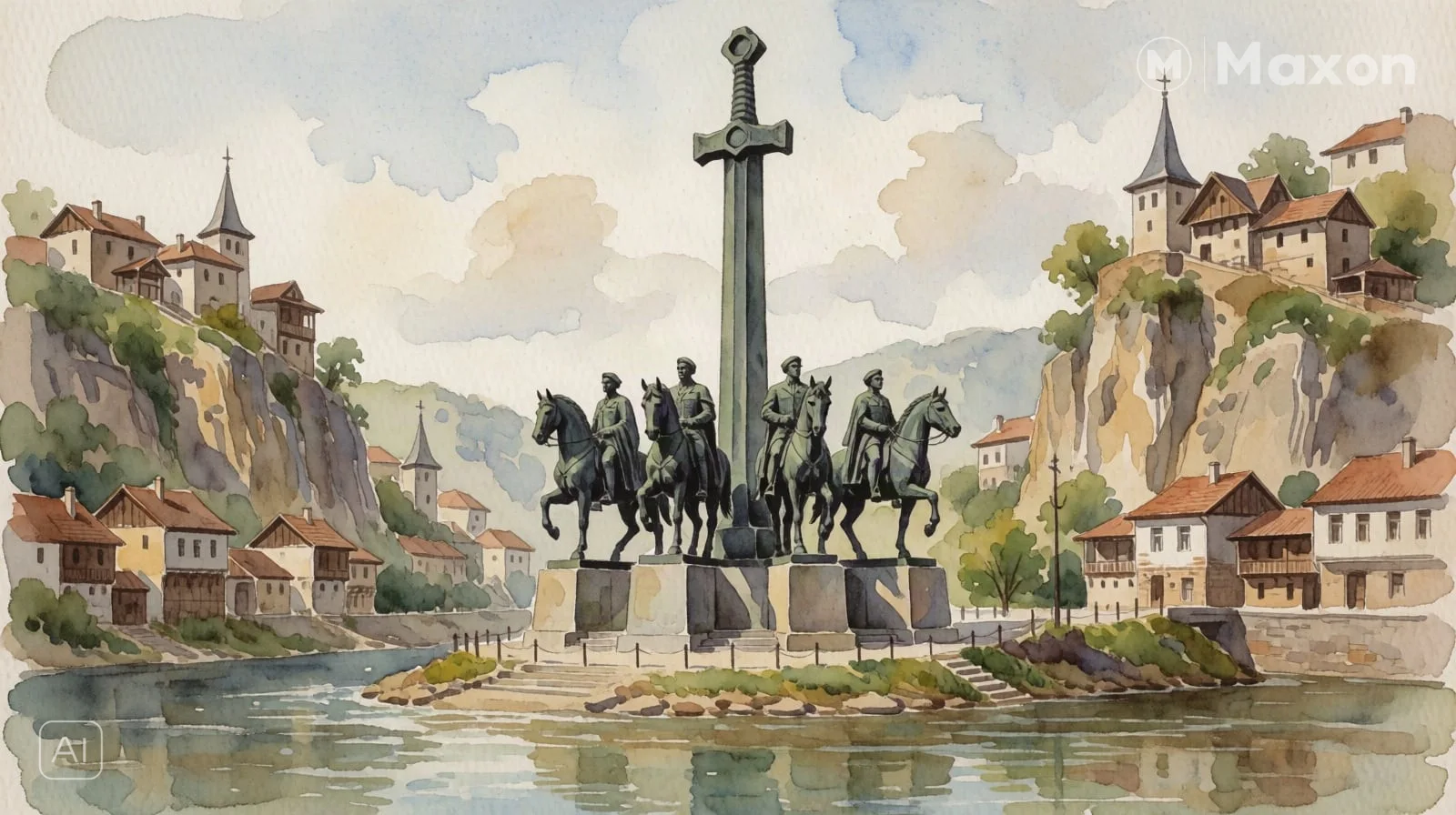
- The Asenevtsi Monument (known locally as "The Horsemen"): Situated on a peninsula within one of the river's loops, this monument honours the tsars Asen, Peter, Kaloyan, and Ivan Asen II. The terrace before it offers an all-encompassing view of the old town, arranged like a theatrical amphitheatre.
- Panoramic Terraces along the Main Street: Specially built viewpoints along Stefan Stambolov Boulevard invite passers-by to pause and watch the evening light illuminate the stone facades.
At sunset, the reflections of street lamps and illuminated buildings dancing on the water create an intimate, gently mysterious atmosphere that lingers long in the memory.
The Varusha Quarter and the Architectural Legacy of Kolyu Ficheto
Above the Samovodska Charshiya lies the Varusha neighbourhood—a peaceful quarter of winding lanes where city noise gives way to serenity. This district retains the authentic everyday ambience of the late 19th century. Courtyards hide behind high stone walls, and carved wooden eaves project gracefully above doorways.
Veliko Tarnovo is deeply tied to Nikola Fichev, known affectionately as Kolyu Ficheto—the master architect and builder of the Bulgarian Revival. His signature craftsmanship can be admired across several landmark buildings:
- The House with the Monkey: A compact urban townhouse featuring expressive brickwork and a small sculpture of a monkey above the entrance, situated in the city's merchant district.
- The Inn of Hadji Nikoli: One of the most significant Revival-era civic buildings in Bulgaria, renowned for its elegant stone arcades and open galleries, now transformed into a cultural and dining venue.
- The Former Konak (Governor's Residence): A monumental edifice that harmoniously blends Ottoman administrative requirements with indigenous Bulgarian construction prowess.
Meticulous attention to detail, a balanced interplay between stone and timber, and enduring structural integrity make these properties timeless benchmarks of the local architectural heritage.
Everyday Life in Veliko Tarnovo: A City of Youth and Culture
While steeped in centuries of history, Veliko Tarnovo is far from frozen in the past. On the contrary, the city hums with dynamic, youthful energy. A central driver of this vitality is St. Cyril and St. Methodius University of Veliko Tarnovo, one of Bulgaria's premier humanities and research hubs, alongside the Vasil Levski National Military University.
Thousands of university students bring lively spirit to the local cafés, bookshops, and art galleries. Parks across the newer quarters—such as Druzhba Park and Marno Pole Park—are filled with families, runners, and leisurely strollers. The urban setting couples the convenience of a compact town, where most destinations can be reached on foot, with the amenities and variety of a major regional centre.
The cultural calendar remains active year-round. Theatre productions, open-air opera festivals staged directly on Tsarevets Hill, literary salons, and contemporary art exhibitions attract audiences from across the country and abroad. The famous "Sound and Light" audio-visual show, illuminating Tsarevets fortress with lasers, chiming bells, and dramatic music, remains an unforgettable spectacle that gathers crowds on the square before the castle gates.
Why Buyers and Investors Choose Veliko Tarnovo
Veliko Tarnovo's geographical position in central northern Bulgaria—near key transport corridors linking Sofia to the Black Sea coast, as well as the Danube Bridge at Ruse to southern Bulgaria—makes it a natural logistics and economic crossroads.
Many seeking an escape from bustling metropolises discover here a welcome balance of modern conveniences, quality farm-to-table food, clean air, and immediate access to nature. The surrounding hills offer wonderful opportunities for day hikes, mountain biking, and picnics. Within just a few kilometres lie the architectural reserve of Arbanasi, the Transfiguration Monastery, and the Holy Trinity Monastery, nestled among the limestone cliffs.
The local property market appeals equally to individuals looking for a characterful permanent residence and investors focusing on long-term student rentals or boutique short-term holiday lets. In this evolving market landscape, the Maxon agency assists buyers in navigating the nuances of each neighbourhood—from authentic homes in the historic old town to contemporary developments in expanding districts.
Veliko Tarnovo remains one of Southeast Europe's most distinctive cities: a place where stone bears witness to tsars, the river carves the cadence of daily life, and the heritage of the Bulgarian Revival blends effortlessly with modern living.