It is August, and the heat of the day has finally given way to a pleasant cool. Picture a meadow among the rolling hills of Strandzha, far from streetlights and the bustle of coastal resorts. Someone is trying to trace a constellation, another has pointed their camera toward the Milky Way, and the rest simply look up and wait. Suddenly, a streak of light flashes across the sky. Conversations pause for a second before someone whispers with excitement: "Did you see that?"
Evenings like these remind us of just how much the night sky has to offer once we step away from the glare of the city. Sometimes all it takes is a clear night, a comfortable seat, and a little patience. Other times, it is well worth traveling dozens of kilometers to witness stars that would otherwise remain completely invisible to us.
Bulgaria boasts some fascinating locations for such experiences—from the heights of the Rhodope Mountains to the tranquil meadows of Strandzha. And for those who prefer to explore the cosmos indoors first, the observatories and planetariums in Varna, Burgas, and other cities open an entirely different door to the stars.
Perseid Night in Strandzha—When Everyone Looks Up
Every year in mid-August comes one of the most anticipated moments for astronomy enthusiasts: the peak of the Perseid meteor shower. People often call it a "shower of shooting stars," although the phenomenon has nothing to do with real stars falling to Earth.
In reality, we are watching tiny particles of dust and rocky debris left behind along the orbital path of Comet Swift–Tuttle (109P/Swift–Tuttle). As Earth passes through this stream of particles, some enter our atmosphere at tremendous speeds, vaporizing to create the brief streaks of light we call meteors.
There is something poetic in knowing that the streak of light we glimpse for barely a second is the result of our planet crossing paths with material left behind by a comet that orbits the Sun roughly once every 133 years.
In Bulgaria, one of the most captivating places to experience this is Strandzha. The "Green Strandzha" association hosts dedicated astronomy nights, including Perseid events near the village of Zvezdets, where participants head out to open meadows far removed from intense urban lighting.
It is a world away from the typical summer evening by the sea. Instead of music from beachside bars, you hear crickets; instead of resort neon, you have the stars; and the main event may last only a fraction of a second. Yet it is precisely for those fleeting moments that staying up late is so rewarding.
You do not need a telescope to watch the Perseids. In fact, having an unobstructed, wide view of the sky is much better, as meteors can appear in any direction. The essentials are clear weather, minimal moonlight, and a sufficiently dark location.
If you plan to join an organized outing, check the date, route, and recommended gear in advance. Programs vary from year to year, and natural conditions always have the final say.
Why Do Stars Look Brighter Away from Cities?
You have likely noticed how dramatically the sky differs above a major city compared to a small mountain village. In Sofia, Varna, or Burgas, we can easily spot the Moon, the brightest stars, and a few planets, but fainter celestial objects simply vanish into the glow of streetlights.
This phenomenon is known as light pollution. Artificial light scatters throughout the atmosphere, brightening the night sky and washing out the contrast between the stars and their background.
This is why viewing the Milky Way often requires getting far away from large settlements. From a suitably dark vantage point, it is visible to the naked eye as an uneven, glowing band stretching across the heavens—our direct view into the dense stellar heart of our own galaxy.
However, darkness is not the only factor. Cloud cover, atmospheric clarity, the phase of the Moon, and an open horizon all play a part. Sometimes a nearby mountain area offers pristine conditions; other times, stubborn clouds can disrupt even the most meticulously planned trip.
That is precisely why astronomers choose the sites for their observatories with such care.
Rozhen—Where the Rhodopes Meet Science
In the central Rhodopes, at an elevation of 1,750 meters above sea level, stands the Rozhen National Astronomical Observatory—one of Bulgaria's most important scientific centers for astronomical research.
Inaugurated in 1981, its location was chosen with great deliberation. Distance from major urban centers, comparatively low light pollution, clean mountain air, and a high number of clear nights combine to create optimal conditions for studying deep-sky objects.
The observatory’s white domes have become an iconic feature of the Rhodope landscape. Beneath them, telescopes operate as scientists study stars, distant galaxies, variable celestial objects, and other phenomena far beyond the reach of the naked human eye.
In 2023, the observatory added a new telescope with a 1.5-meter mirror—a significant milestone for professional astronomical research in the country.
Notably, an active research observatory functions quite differently from a casual tourist stargazing platform. The telescopes are dedicated primarily to scientific work, and standard visitor tours at Rozhen are organized during daylight hours, meaning they do not include nighttime viewing through the scientific instruments.
Even so, a journey to the area makes for a wonderful blend of science, alpine scenery, and relaxation. Pamporovo and Chepelare are just a short drive away, and the Rhodopes offer countless trails and scenic spots for both summer hikes and winter getaways.
If you love the mountains and are considering a holiday retreat of your own, take a look at our property listings in Pamporovo. A mountain home offers unique rewards not just during ski season, but also on crisp summer evenings when the surrounding nature takes on a completely different character.
Varna—A City with a Long Cosmic Tradition
Not every inspiring encounter with astronomy calls for an expedition high into the mountains. Sometimes, a leisurely stroll through the Sea Garden is all it takes.
That is where you will find the "Nicolaus Copernicus" Public Astronomical Observatory and Planetarium, opened in 1968. It was Bulgaria's first integrated complex to bring together an astronomical observatory, a planetarium, and a tower housing a Foucault pendulum.
The pendulum itself deserves special mention. The Foucault pendulum is an elegant experiment that provides visual proof of the Earth's rotation on its axis. As the pendulum swings, the plane of its oscillation gradually shifts relative to the floor beneath it—a deceptively simple demonstration of planetary motion we otherwise never feel.
The planetarium offers visitors the chance to learn about constellations, the mechanics of celestial bodies, and fascinating astronomical phenomena even when the skies outside are completely overcast.
The Varna observatory also operates an observational branch in the village of Avren, sustaining a regional tradition that has bridged education, observation, and scientific curiosity for decades.
For families with children, it offers a delightful itinerary: a day by the sea can easily combine beach time and park strolls with a captivating introduction to planets, stars, and the mysteries of the universe.
Burgas—A Cosmic Journey Steps from the Sea
In Burgas, science has acquired a relatively new and striking architectural presence.
Located at the Sea Station within the public port zone is the planetarium of the "PlanetUM" Science Center, opened in 2023. The building resembles a giant, polished metallic sphere that catches the eye long before you step inside.
Beneath its eight-meter projection dome, visitors can immerse themselves in visual simulations of the cosmos and learn about planets, stars, and distant galaxies. Seating 50 people, the hall is designed specifically for engaging educational programs that present astronomy in an accessible, family-friendly way.
The distinction between a planetarium and an observatory is worth keeping in mind. Inside a planetarium, you watch a scientifically calibrated projection of the sky rather than real stars through an optical telescope. Yet this is precisely what allows you to travel through the universe regardless of the weather outside.
What makes it especially appealing is how easily it fits into an ordinary day in town—a walk along the harbor, a show at the planetarium, and dinner by the water.
And if you wish to explore the natural world around Burgas further, our article on Via Pontica and the lakes around the city tells the story of another kind of celestial traveler—the migratory birds that pass over this coastline every year.
More Stargazing Destinations Across Bulgaria
Rozhen, Strandzha, Varna, and Burgas are merely highlights on the country’s astronomical map.
In Smolyan, another venerable planetarium with a rich educational legacy hosts regular star shows and astronomy lectures. Visiting is a great addition to any Rhodope road trip and a chance to view the mountain region through an unusual lens.
Near Belogradchik, there is an astronomical observatory set against the dramatic silhouette of the famous rock formations, offering a breathtaking backdrop for night-sky photographers. Bear in mind that the observatory itself may have visitor restrictions, so it is best not to count on drop-in access without checking ahead.
The Plana region and the darker pockets around Sofia also offer accessible spots for casual stargazing. You do not have to travel to the far corner of the country to catch a bright meteor or explore lunar craters with a pair of binoculars.
For those based in the capital, these short evening excursions are another great way to enjoy nature close to home. In our Sofia city guide, we highlight the perks of having mountain landscapes right on the edge of daily city life.
Perseids, Comets, Eclipses—When Does the Sky Put on Its Best Show?
The beauty of stargazing lies in the fact that every season brings something new. While not all events recur annually, several can be anticipated with regular consistency.
The Perseids usually peak around August 12–13. They are best viewed from a dark location well away from urban lights, though exceptionally bright fireballs can occasionally be spotted even from suburbs and smaller towns.
The Milky Way is at its most striking on clear summer nights. To appreciate its delicate glow, pick a spot with minimal light pollution and, ideally, plan your outing around a new moon.
Lunar eclipses can be enjoyed safely without any protective eye gear whenever they are visible from Bulgaria. During totality, the Moon often takes on a dramatic coppery-red tint as sunlight filtering through Earth's atmosphere reaches its surface.
Solar eclipses are an entirely different experience and demand certified eye protection. Even during a partial eclipse, never look directly at the Sun without specialized, certified solar filters. Regular sunglasses are completely inadequate, and optical instruments like binoculars or telescopes require dedicated solar aperture filters.
Comets are far more unpredictable visitors. Many remain faint and require telescopes, but occasionally one brightens enough to become a naked-eye spectacle.
For any of these events, it is always wise to verify the local weather forecast, the lunar phase, and the exact viewing angles from your location.
And Sometimes, the Finest View Is from Your Own Balcony
As alluring as remote mountain meadows and silent peaks may be, not every memorable celestial event demands a long trek. Occasionally, a bright phenomenon can catch us completely by surprise right in the middle of town.
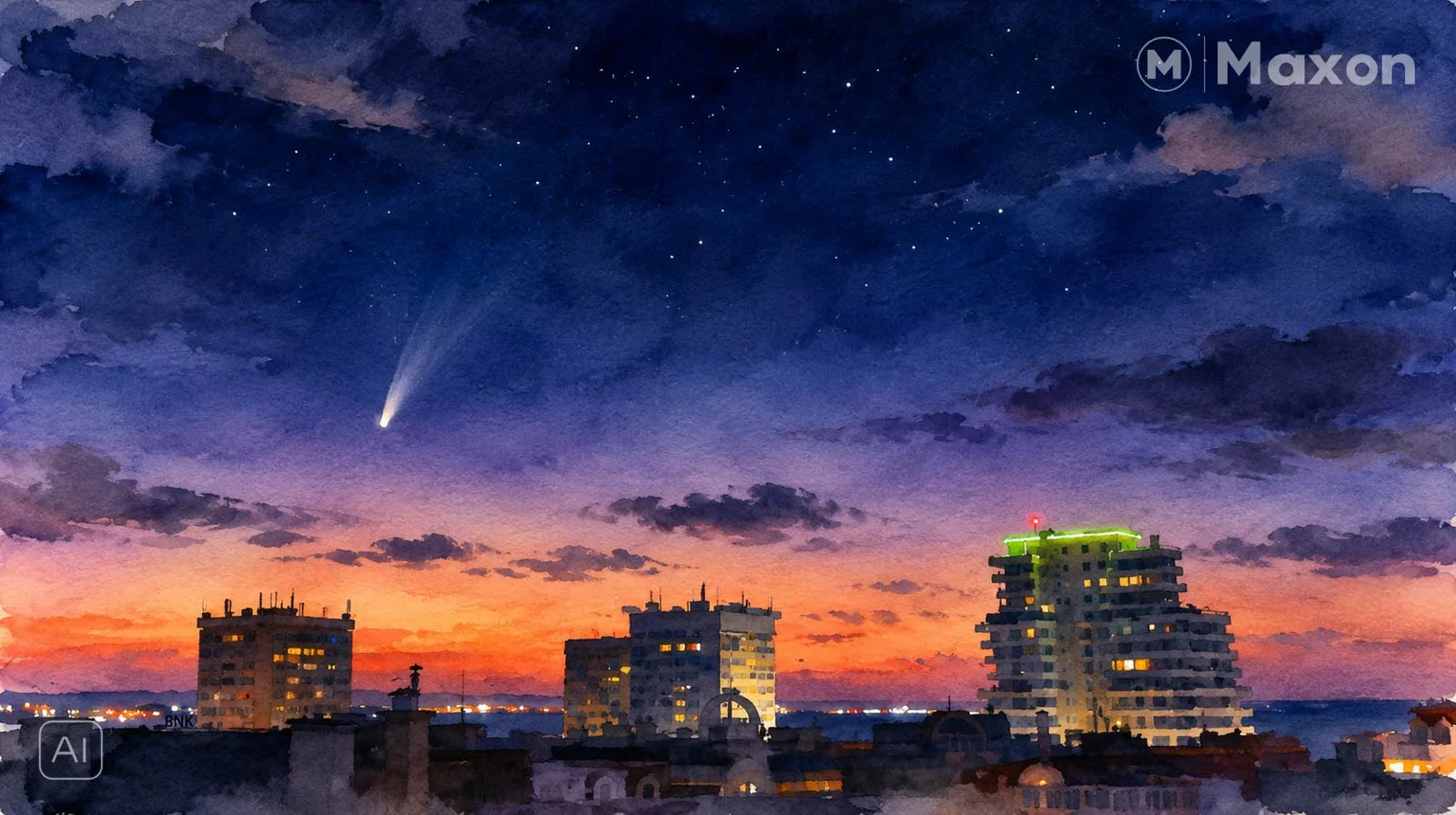
In July 2020, for instance, Comet C/2020 F3 (NEOWISE) became visible across the Northern Hemisphere. Early in the month, it could be spotted low over the northeastern horizon before dawn, and later on, during evening hours in the northwest. Even in coastal cities like Burgas, residents could catch sight of it right from their balconies if they had an unobstructed view toward the right slice of sky.
It is one of those understated pleasures we rarely think about when choosing a home. A higher floor, a generous terrace, and an open panoramic view over the sea or the horizon can occasionally treat you to an unexpected encounter with the Moon, a luminous planet, or a passing comet. Of course, a frontline address does not automatically guarantee ideal viewing for every event—orientation, neighboring structures, ambient lighting, and compass direction all matter.
For those who own a second home by the sea or in the mountains, the possibilities expand even further.
Imagine having an apartment along the Southern Black Sea coast. You hear about an upcoming Perseid viewing night in Strandzha and decide on a whim to spend the evening in the hills. There is no need to hunt for hotel rooms on short notice—you can plan your outing around the forecast and return to your own familiar space afterward.
The same holds true for mountain properties in the Rhodopes. A home or apartment there can serve as your launchpad for summer hikes, winter holidays, and quiet evenings of stargazing far from the urban glare.
If this lifestyle appeals to you, explore our current properties in Primorsko, Burgas, or Pamporovo. When choosing the right property, consider not only the view, but also travel convenience, year-round accessibility, and the recreational options available nearby.
How to Plan Your First Night Under the Stars
You do not need an expensive telescope to get started. For your first stargazing trip, comfortable layers, a warm drink, a blanket or camp chair, and a dash of curiosity are often all you need.
Pick a safe, accessible spot with an open view of the sky. Check the cloud cover forecast and the phase of the Moon, especially if you hope to observe faint stars or the Milky Way. Give your eyes at least twenty minutes to adjust to the dark, and avoid looking at bright phone screens, which quickly reset your night vision.
If you are watching for Perseids, resist the urge to stare at a single point. Settle into a comfortable position with a wide field of view and let the sky surprise you. When exploring mountain areas or nature parks after dark, be mindful of designated paths, local access regulations, and group safety.
Above all, do not expect every night to look like a long-exposure astrophotograph. The human eye perceives the night sky quite differently from a digital sensor. Yet even a single brilliant streak across the constellations is often more than enough to make an evening unforgettable.
A Sky We Can Always Return To
There is something profoundly grounding about looking upward and realizing that these very same stars inspired people long before modern cities ever existed. Today, we have telescopes, space probes, and planetariums that help us decode the cosmos with remarkable precision. Yet the quiet wonder of a clear, starry night remains unchanged.
Whether you spend it in the stillness of Strandzha, high in the Rhodopes, along the shoreline, or on your own balcony, sometimes the most rewarding journey begins with a gesture as simple as lifting your eyes to the sky.