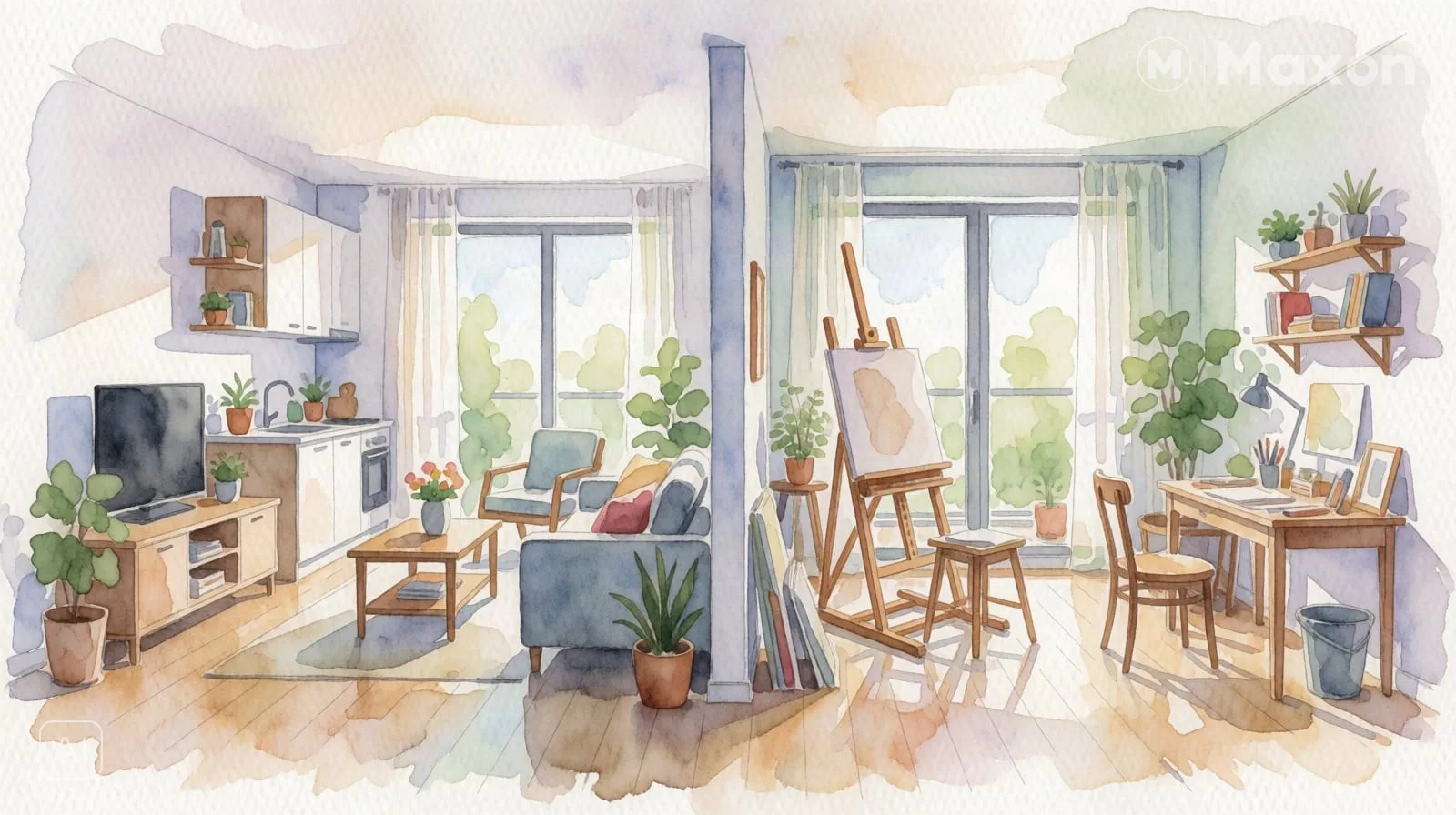
Imagine viewing two properties in the same residential building. Both have a living room with a kitchenette, a bathroom, a nice view, and plenty of space for comfortable living. One is marketed as an apartment, while the other is listed as an atelier (atelie). At first glance, there is hardly any difference. Why, then, are they recorded differently in the paperwork?
The answer does not lie in the furnishing or the square footage, but in the official intended use of the property. And while this distinction may seem purely technical, it can affect address registration, mortgage financing, ongoing costs, and future resale.
This subject is particularly vital for international buyers, who frequently see the terms studio, apartment, and atelier in Bulgarian property listings without realizing that they do not always mean the same thing.
What is actually the difference between an atelier and an apartment?
Under the Bulgarian Spatial Development Act (ZUT), a dwelling (apartament or zhilishte) is a designated unit intended to satisfy residential needs. To qualify for this status, it must fulfill specific architectural and technical statutory requirements.
An atelier, on the other hand, is an independent unit designated for individual creative activities. The law allows ateliers to be built within residential buildings, which is why you naturally find them on the same floor, right next to regular apartments.
Why do property developers sometimes design ateliers instead of apartments?
The reason often stems from the specific spatial characteristics of the unit. For instance, a unit might face entirely north or lack the legally required dedicated storage room. Such aspects can prevent it from fulfilling all the statutory requirements for a residential home, without necessarily making the space inconvenient for its intended use.
This is precisely why an atelier can feature a wonderful interior, a fully fitted kitchen, and a bathroom, yet still lack the legal status of an apartment.
What does the law require for both property types?
For residential dwellings, Bulgarian legislation prescribes a specific minimum layout. Under Article 40 of the ZUT, every home must feature an independent entrance, at least one living room, a kitchen or kitchenette, a bathroom with a toilet, and a storage room, which may also be located outside the apartment itself.
Additional technical rules are set out in Ordinance No. 7 on spatial development rules and normative standards. These regulate criteria such as natural daylight, orientation, and ceiling heights.
With ateliers, the requirements are different. For instance, regulations require an independent sanitary facility, but they do not mandate the exact same room composition as a residential home.
Here is a summary of the primary differences:
| Feature | Apartment | Atelier |
|---|---|---|
| Official intended use | For residential living | For individual creative activity |
| Kitchen or kitchenette | Mandatory | Not mandatory under residential rules |
| Storage room | Mandatory | Not mandatory under the same rules |
| Orientation and natural light | Specific residential standards | Different requirements |
| Address registration | Standard procedure when conditions are met | Possible in certain cases, but not guaranteed |
| Bank mortgage financing | Standard bank conditions | Additional restrictions may apply |
| Change of legal status | Not required | Possible if statutory conditions are met |
This table outlines general distinctions, but it does not replace a thorough check of the specific property. In older buildings or properties with a complex history of alterations, additional considerations may apply.
Another essential detail is floor area. Two properties with the exact same listed square footage can feel entirely different depending on their layout and common areas. In our article “How is Apartment Square Footage Calculated in Bulgaria?”, we explain what lies behind the figures in property listings.
Didn't the law equate ateliers to apartments in 2021?
This is one of the most common misconceptions on the topic.
In 2021, an amendment was indeed introduced to the ZUT, stating that ateliers are considered residential units when determining the intended use of the building.
The key words here are "of the building".
This rule matters for determining whether a building qualifies as residential or mixed-use. It does not mean that all existing ateliers automatically received the legal status of apartments.
Therefore, if your property is listed as an atelier for creative activities in the title deed and approved architectural plans, the 2021 legal amendment does not by itself convert it into an apartment.
Can you live in an atelier and register your address there?
This is perhaps the most critical practical question for most prospective buyers.
There is no question that many ateliers are furnished and used as regular homes. However, daily use and official legal designation are two different things. The ZUT requires structures to be used according to their approved purpose; hence, it is inaccurate to claim that an atelier can unconditionally substitute for an apartment.
What about permanent and current address registration?
The situation here is nuanced. Bulgarian court practice includes rulings establishing that address registration is not necessarily precluded simply because a property is designated as an atelier. Factors such as actual use, habitability, and individual circumstances can carry weight.
However, administrative practices across different municipal offices are not always uniform.
Therefore, if you plan to use an atelier as your primary home, it is prudent to verify the possibility of address registration with the local municipality prior to purchase. For international buyers, this is particularly important when the address will be required for administrative residency procedures in Bulgaria.
Are taxes and utility bills higher for an atelier?
Several myths surround this issue. One of the most widespread is that atelier owners must always pay commercial electricity rates and significantly higher property taxes.
In reality, the situation is not that straightforward.
Real estate property tax. Bulgarian law provides a 50% tax reduction for a property that qualifies as a primary residence. Under certain conditions, this relief may also apply to an atelier that effectively serves as a primary home. However, this is not automatic and must be assessed by the respective municipal administration.
Household waste collection fee. The amount and calculation method depend on local municipal ordinances, the designated use, and applicable rules for the specific property.
Electricity. The distinction between household and non-household consumers depends on the purpose for which the electricity is consumed and the supplier’s general terms. The label "atelier" alone does not automatically mean electricity will be billed at commercial rates.
Similar questions can arise regarding water supply and other utilities. The most reliable approach is to inspect existing utility contracts and billing terms for the specific property rather than relying on general assurances.
It is also essential to separate these recurring annual expenses from one-off acquisition costs. Notary fees, local transfer tax, and land registry registration costs are separate matters, which we cover in detail in our guide “Notary Fees and Expenses When Buying Property in Bulgaria”.
Can you buy an atelier with a mortgage?
Yes, bank financing is possible, but terms and conditions are not always identical to those for standard residential properties.
Each commercial bank maintains its own collateral valuation and risk assessment criteria. Depending on the specific unit, a lender might set additional conditions, require a higher down payment, or offer a different financing structure.
There is no universal rule barring the financing of ateliers, just as there is no guarantee that every bank will accept them.
If your purchase depends on mortgage lending, request an advance approval from the bank for the specific unit and its documented status before placing a deposit or signing a preliminary agreement.
Can an atelier be converted into an apartment?
Yes, in certain cases it is possible to change the designated use from an atelier to a residential dwelling. However, not every atelier can achieve this status.
Article 147a of the ZUT provides a procedure for changing designated use without carrying out construction and assembly work, provided that the relevant legal requirements are met and an approval is issued by the municipal chief architect.
The essential requirement is that the unit must fully comply with all statutory standards for its new residential designation.
For example, if a compliant storage space is missing, an architectural solution might be feasible. However, if the issue stems from orientation, natural light, or structural characteristics that cannot be easily modified, the procedure can prove significantly more complicated or practically impossible.
Where internal alterations are required, additional designs, permits, and neighbor consents may be necessary depending on the situation.
For this reason, do not purchase an atelier under the mere assumption that its status can be easily changed later. Obtaining preliminary feedback from a licensed architect can prevent substantial expenses and disappointment.
What should you check before purchasing?
Whether you are looking for a compact coastal retreat, an apartment in Sofia, or a space to combine work and personal life, the most critical step is knowing exactly what you are purchasing.
It is particularly beneficial to examine the following documents and factors:
- Title deed and cadastral scheme — What is the official designated use of the property, and do the records match?
- Approved architectural design — Was the unit designed as an atelier or a dwelling, and are there discrepancies with the physical layout?
- Address registration — Is registration permitted for this specific unit according to the competent municipal authority?
- Taxes and utility services — How is the property declared for tax purposes, and under what tariff conditions are utilities provided?
- Bank financing — Does your chosen lender accept this property category as collateral?
- Future conversion potential — Is there a realistic prospect of changing the designated use, and what procedures would be involved?
A buyer does not need to become a lawyer or an architect. However, it is essential to know which questions to ask and which professionals can provide reliable answers.
In our article “Finding a Property Is Easy. Making the Right Purchase Is Quite Another”, we discuss why due diligence, professional guidance, and attention to detail are paramount when acquiring real estate in Bulgaria.
Atelier or apartment — which is the better choice?
There is no single correct answer. Everything depends on how you intend to use the property and what your long-term plans are.
For someone seeking an inspiring space for creative work, an atelier may be an ideal match. Its purchase price may also be more attractive than that of a comparable apartment, though this is not a universal rule.
However, if you are looking for a permanent family home, rely on bank financing, or require smooth address registration, standard residential status generally offers greater certainty.
For investment acquisitions, it is equally important to plan ahead. A property's legal status can influence its everyday use, rental potential, financing options, and eventual resale value. Clarifying these specifics well before closing is always the best strategy.
The right choice begins with the right questions
Sometimes the visual difference between an atelier and an apartment is virtually undetectable during a viewing. Both properties can be bright, comfortable, and beautifully furnished. Yet the legal documentation tells another, equally vital part of the story.
Before choosing a property based solely on photographs, floor plans, or price, take the time to understand its legal designation and the practical terms that come with it.
A great purchase is not necessarily the one that looks most appealing at first glance, but the one that truly meets your needs — not only today, but for years to come.
---
This article is provided for informational purposes and reflects the regulatory framework as of 6 November 2026. It does not constitute individual legal or architectural advice. For any specific property transaction, consulting current statutory regulations and verifying the property's legal documentation is strongly recommended.